给定一个整数数组 nums 和一个整数目标值 target,请你在该数组中找出 和为目标值 target两个 整数,并返回它们的数组下标。
你可以假设每种输入只会对应一个答案,并且你不能使用两次相同的元素。
你可以按任意顺序返回答案。
示例 1:
1
2
3
输入:nums = [2,7,11,15], target = 9 输出:[0,1] 解释:因为 nums[0] + nums[1] == 9 ,返回 [0, 1] 。
示例 2:
1
2
输入:nums = [3,2,4], target = 6 输出:[1,2]
示例 3:
1
2
输入:nums = [3,3], target = 6 输出:[0,1]
提示:
2 <= nums.length <= 104-109 <= nums[i] <= 109-109 <= target <= 109只会存在一个有效答案
题解 暴力 1 2 3 4 5 6 7 8 9 10 11 12 13 class Solution { public int [] twoSum(int [] nums, int target) { int n = nums.length; for (int i = 0 ; i < n; i++) { for (int j = i + 1 ; j < n; j++) { if (nums[i] + nums[j] == target) { return new int [] {i, j}; } } } return new int [0 ]; } }
HashMap 思路及算法
注意到方法一的时间复杂度较高的原因是寻找 target - x 的时间复杂度过高。因此,我们需要一种更优秀的方法,能够快速寻找数组中是否存在目标元素。如果存在,我们需要找出它的索引。
使用哈希表,可以将寻找 target - x 的时间复杂度降低到从 O(N) 降低到 O(1)。
这样我们创建一个哈希表,对于每一个 x ,我们首先查询哈希表中是否存在 target - x,然后将 x 插入到哈希表中,即可保证不会让 x 和自己匹配。
1
2
3
4
5
6
7
8
9
10
11
12
13
class Solution { public int [] twoSum(int [] nums, int target) { Map<Integer, Integer> hashMap = new HashMap <Integer, Integer>(); for (int i = 0 ; i < nums.length; i++) { if (hashMap.containsKey(target - nums[i])) { return new int [] {hashMap.get(target - nums[i]), i}; } hashMap.put(nums[i], i); } return new int [0 ]; } }
给你一个字符串数组,请你将 字母异位词 组合在一起。可以按任意顺序返回结果列表。
字母异位词是通过重新排列不同单词或短语的字母而形成的单词或短语,并使用所有原字母一次。
示例 1:
输入: strs = [“eat”, “tea”, “tan”, “ate”, “nat”, “bat”]
输出: [[“bat”],[“nat”,”tan”],[“ate”,”eat”,”tea”]]
解释:
在 strs 中没有字符串可以通过重新排列来形成 "bat"。
字符串 "nat" 和 "tan" 是字母异位词,因为它们可以重新排列以形成彼此。
字符串 "ate" ,"eat" 和 "tea" 是字母异位词,因为它们可以重新排列以形成彼此。
示例 2:
输入: strs = [“”]
输出: [[“”]]
示例 3:
输入: strs = [“a”]
输出: [[“a”]]
提示:
1 <= strs.length <= 1040 <= strs[i].length <= 100strs[i] 仅包含小写字母
题解 排序 思路:将字符串包含的字符取出来进行排序,将排序后的数组作为字符串,作为key,value为原字符串数组中的字符串
1
2
3
4
5
6
7
8
9
10
11
12
13
class Solution { public List<List<String>> groupAnagrams (String[] strs) { HashMap<String, List<String>> hashMap = new HashMap <>(); for (int i = 0 ; i < strs.length; i++) { char [] chars = strs[i].toCharArray(); Arrays.sort(chars); String key = new String (chars); hashMap.computeIfAbsent(key, _ -> new ArrayList <>()).add(strs[i]); } return new ArrayList <>(hashMap.values()); } }
computeIfAbsent :key 不存在,执行函数生成 value 放入 map,并返回这个 value;key 存在,直接返回已存在的 value。
计数 由于互为字母异位词的两个字符串包含的字母相同,因此两个字符串中的相同字母 出现的次数 一定是相同 的,故可以将每个字母出现的次数使用字符串表示,作为哈希表的键。
拼接字母和出现次数作为key,满足key的字符串作为value
1 2 3 4 5 6 7 8 9 10 11 12 13 14 15 16 17 18 19 20 21 22 23 24 25 26 27 28 29 30 31 32 33 34 35 36 37 class Solution { public List<List<String>> groupAnagrams (String[] strs) { Map<String, List<String>> map = new HashMap <String, List<String>>(); for (String str : strs) { int [] counts = new int [26 ]; int length = str.length(); for (int i = 0 ; i < length; i++) { counts[str.charAt(i) - 'a' ]++; } StringBuffer sb = new StringBuffer (); for (int i = 0 ; i < 26 ; i++) { if (counts[i] != 0 ) { sb.append((char ) ('a' + i)); sb.append(counts[i]); } } String key = sb.toString(); List<String> list = map.getOrDefault(key, new ArrayList <String>()); list.add(str); map.put(key, list); } return new ArrayList <List<String>>(map.values()); } }
给定一个未排序的整数数组 nums ,找出数字连续的最长序列(不要求序列元素在原数组中连续)的长度。
请你设计并实现时间复杂度为 O(n) 的算法解决此问题。
示例 1:
1
2
3
输入:nums = [100,4,200,1,3,2] 输出:4 解释:最长数字连续序列是 [1, 2, 3, 4]。它的长度为 4。
示例 2:
1
2
输入:nums = [0,3,7,2,5,8,4,6,0,1] 输出:9
示例 3:
1
2
输入:nums = [1,0,1,2] 输出:3
提示:
0 <= nums.length <= 105-109 <= nums[i] <= 109
题解 1 2 3 4 5 6 7 8 9 10 11 12 13 14 15 16 17 18 19 20 21 class Solution { public int longestConsecutive (int [] nums) { Set<Integer> st = new HashSet <Integer>(); for (int num : nums) { st.add(num); } int ans = 0 ; for (int num : st) { if (!st.contains(num - 1 )) { int current = num; int len = 1 ; while (st.contains(current + 1 )) { current++; len++; } ans = Math.max(ans, len); } } return ans; } }
给定一个数组 nums,编写一个函数将所有 0 移动到数组的末尾,同时保持非零元素的相对顺序。
请注意 ,必须在不复制数组的情况下原地对数组进行操作。
示例 1:
1
2
输入: nums = [0,1,0,3,12] 输出: [1,3,12,0,0]
示例 2:
提示 :
1 <= nums.length <= 104-231 <= nums[i] <= 231 - 1
**进阶:**你能尽量减少完成的操作次数吗?
1 2 3 4 5 6 7 8 9 10 11 12 13 14 15 class Solution { public void moveZeroes (int [] nums) { int index = 0 ; for (int i = 0 ; i < nums.length; i++ ){ if (nums[i] != 0 ){ nums[index] = nums[i]; index++; } } for (int i = index; i < nums.length; i++){ nums[i] = 0 ; } } }
1
2
3
4
5
6
7
8
9
10
11
12
13
class Solution { public void moveZeroes (int [] nums) { int j = 0 ; for (int i = 0 ; i < nums.length; i++) { if (nums[i] != 0 ) { int temp = nums[i]; nums[i] = nums[j]; nums[j] = temp; j++; } } } }
10.15
1
2
3
4
5
6
7
8
9
10
11
12
13
14
class Solution { public void moveZeroes (int [] nums) { int j = 0 ; for (int i = 0 ; i < nums.length; i++) { if (nums[i] != 0 ) { nums[j] = nums[i]; j++; } } for (; j < nums.length; j++) { nums[j] = 0 ; } } }
相向双指针 | 𝐺ℎ𝑎𝑜 の 𝐵𝑙𝑜𝑔
相向双指针 | 𝐺ℎ𝑎𝑜 の 𝐵𝑙𝑜𝑔
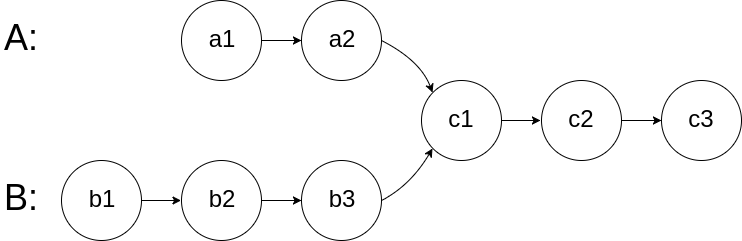
给你两个单链表的头节点 headA 和 headB ,请你找出并返回两个单链表相交的起始节点。如果两个链表不存在相交节点,返回 null 。
图示两个链表在节点 c1 开始相交**:**
题目数据 保证 整个链式结构中不存在环。
注意 ,函数返回结果后,链表必须 保持其原始结构 。
自定义评测:
评测系统 的输入如下(你设计的程序 不适用 此输入):
intersectVal - 相交的起始节点的值。如果不存在相交节点,这一值为 0listA - 第一个链表listB - 第二个链表skipA - 在 listA 中(从头节点开始)跳到交叉节点的节点数skipB - 在 listB 中(从头节点开始)跳到交叉节点的节点数
评测系统将根据这些输入创建链式数据结构,并将两个头节点 headA 和 headB 传递给你的程序。如果程序能够正确返回相交节点,那么你的解决方案将被 视作正确答案 。
示例 1:
1
2
3
4
5
6
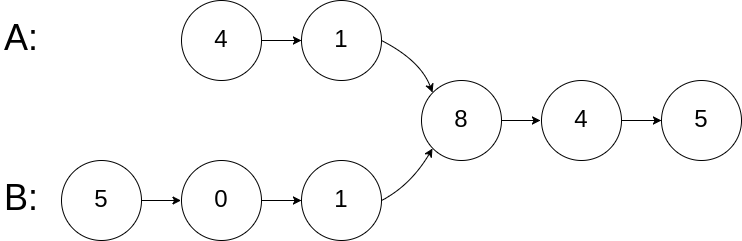
输入:intersectVal = 8, listA = [4,1,8,4,5], listB = [5,6,1,8,4,5], skipA = 2, skipB = 3 输出:Intersected at '8' 解释:相交节点的值为 8 (注意,如果两个链表相交则不能为 0)。 从各自的表头开始算起,链表 A 为 [4,1,8,4,5],链表 B 为 [5,6,1,8,4,5]。 在 A 中,相交节点前有 2 个节点;在 B 中,相交节点前有 3 个节点。 — 请注意相交节点的值不为 1,因为在链表 A 和链表 B 之中值为 1 的节点 (A 中第二个节点和 B 中第三个节点) 是不同的节点。换句话说,它们在内存中指向两个不同的位置,而链表 A 和链表 B 中值为 8 的节点 (A 中第三个节点,B 中第四个节点) 在内存中指向相同的位置。
示例 2:
1
2
3
4
5
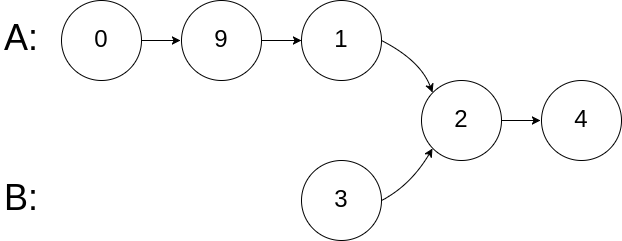
输入:intersectVal = 2, listA = [1,9,1,2,4], listB = [3,2,4], skipA = 3, skipB = 1 输出:Intersected at '2' 解释:相交节点的值为 2 (注意,如果两个链表相交则不能为 0)。 从各自的表头开始算起,链表 A 为 [1,9,1,2,4],链表 B 为 [3,2,4]。 在 A 中,相交节点前有 3 个节点;在 B 中,相交节点前有 1 个节点。
示例 3:
1
2
3
4
5
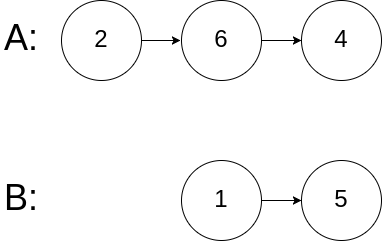
输入:intersectVal = 0, listA = [2,6,4], listB = [1,5], skipA = 3, skipB = 2 输出:No intersection 解释:从各自的表头开始算起,链表 A 为 [2,6,4],链表 B 为 [1,5]。 由于这两个链表不相交,所以 intersectVal 必须为 0,而 skipA 和 skipB 可以是任意值。 这两个链表不相交,因此返回 null 。
提示:
listA 中节点数目为 mlistB 中节点数目为 n1 <= m, n <= 3 * 1041 <= Node.val <= 1050 <= skipA <= m0 <= skipB <= n如果 listA 和 listB 没有交点,intersectVal 为 0
如果 listA 和 listB 有交点,intersectVal == listA[skipA] == listB[skipB]
**进阶:**你能否设计一个时间复杂度 O(m + n) 、仅用 O(1) 内存的解决方案?
题解 10.15
1
2
3
4
5
6
7
8
9
10
public class Solution { public ListNode getIntersectionNode (ListNode headA, ListNode headB) { ListNode A = headA, B = headB; while (A != B) { A = A != null ? A.next : headB; B = B != null ? B.next : headA; } return A; } }
206. 反转链表
给你单链表的头节点 head ,请你反转链表,并返回反转后的链表。
示例 1:
1
2
输入:head = [1,2,3,4,5] 输出:[5,4,3,2,1]
示例 2:
1
2
输入:head = [1,2] 输出:[2,1]
示例 3:
提示:
链表中节点的数目范围是 [0, 5000]
-5000 <= Node.val <= 5000
**进阶:**链表可以选用迭代或递归方式完成反转。你能否用两种方法解决这道题?